
General Abdel Fattah al-Burhan, commander of the Sudanese Armed Forces (SAF) and de facto head of state since the 2021 military takeover, has shifted from exploratory engagement with the United States in August to explicit bargaining. On 15 October in Cairo, immediately after conferring with Egyptian President Abdel Fattah al-Sisi, Burhan met U.S. Africa adviser Massad Boulos to set out Sudan’s conditions for participation in the American diplomatic initiative. This shift comes amid Burhan’s deliberate political repositioning: distancing his administration from Iran, banning a Brotherhood-aligned Islamist current, and aligning more closely with Cairo’s military-led model. These moves have opened political space with both Egypt and Washington, which view the pivot as strategically advantageous. Washington has been signalling a package of incentives alongside its diplomatic push. This includes discussions around targeted sanctions relief and a proposed U.S. business delegation focused on mining and energy investment, intended to offer Burhan alternatives to deepening economic ties with Moscow. This economic component is central to the U.S. effort to anchor its engagement in something tangible rather than purely political assurances.
Burhan’s central proposition is straightforward: Sudan will engage, but only if the Rapid Support Forces (RSF) are cut off from their external support base. The RSF, commanded by Mohamed Hamdan Dagalo (‘Hemeti’), is a powerful paramilitary force that broke from the state in April 2023 and has since fought the SAF for control of the country. Dagalo, formerly Burhan’s deputy in the transitional government, is now his principal rival. The RSF controls most of Darfur and parts of Khartoum and relies heavily on foreign financial and military support, particularly from the UAE. Initial discussions with the U.S. in August focused on short-term ceasefire and humanitarian access arrangements intended as confidence-building steps. In Cairo, Burhan shifted the agenda decisively, demanding that Washington directly pressure Abu Dhabi to end its support for Dagalo’s forces. This marked a move from tactical humanitarian engagement to strategic political conditionality, reframing the conflict as a test of U.S. resolve in dealing with its Gulf partners and defending the principle of state authority.
Burhan’s administration based in Port Sudan has repeatedly made clear it will not treat the RSF as a legitimate political counterpart. This refusal is rooted in regime doctrine: recognising the RSF as an equal actor would undermine the SAF’s claim to be the sole sovereign authority in Sudan. That position has held despite fluctuating battlefield dynamics. The SAF retains institutional depth and territorial control in the east, north and centre, but faces a more contested environment in Darfur, where El Fasher remains its last major urban foothold and is under sustained RSF pressure. This red line is about the post-war order, not immediate tactical realities.
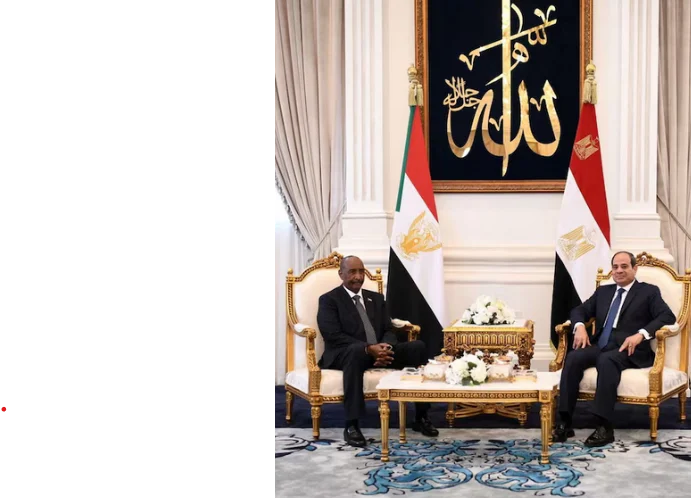
Cairo’s fingerprints are visible throughout the choreography. Egypt’s zero tolerance for any Muslim Brotherhood-adjacent movement, combined with Port Sudan’s recent ban on an Islamist current aligned with both the Brotherhood and Tehran, amounts to a deliberate political down-payment to Sisi. The sequence of meetings — Sisi first, Boulos second — underscores Egypt’s role as a gatekeeper in Burhan’s external relations. Cairo wants a neighbour that is both hostile to Islamist politics and anchored to the state military, a vision that mirrors Burhan’s own red lines and provides him political cover to reject any parity with the RSF. At the same time, Burhan’s demand for U.S. pressure on the UAE directly targets the RSF’s external support network. This support has increased since June after the RSF and Libyan National Army ousted Burhan’s forces from the tri-border area, helping to firm up a supply route between the UAE via Kufra Airport and into Sudan. Only Washington has the leverage to test or alter Emirati behaviour at speed. If that leverage isn’t exercised, Burhan can argue that the diplomatic initiative faltered due to U.S. inaction rather than Sudanese obstruction, all while holding firm to his refusal to legitimise the RSF.
Washington is pursuing more than peacemaking. The Red Sea is the strategic canvas, and Port Sudan is the prize. Alongside its diplomatic overtures, the U.S. has floated a targeted economic incentive package centred on sanctions relief and a proposed U.S. mining and energy investment delegation. This economic component is coupled with quiet intelligence liaison in Port Sudan, signalling Washington’s intent to counter Russian efforts to secure naval access to the Red Sea and establish a more enduring footprint if the diplomatic track holds. The limits of this approach are clear. Pressuring Abu Dhabi sits beyond Boulos’s mandate and would require direct engagement from the White House to have any real effect on Emirati behaviour. The current track is effectively being run through the State Department and Boulos, which can manage humanitarian and economic signalling but lacks the authority to enforce strategic shifts by Gulf partners. Without senior-level backing, the initiative risks stalling. If the White House does not step in, U.S. leverage will erode quickly, and Moscow’s more concrete offers of security guarantees and maritime access will remain attractive to Burhan. For Burhan, these economic incentives are not peripheral - they are central to his political calculus. Delays in delivering the promised delegation and sanctions relief have already frustrated senior figures in the Sovereignty Council. Officers sceptical of closer alignment with Washington expect tangible returns for their loyalty. If those incentives do not materialise soon, Burhan’s internal coalition will be harder to hold together, narrowing his diplomatic room to manoeuvre.
Burhan’s 15 October meeting in Cairo represents a decisive turn: Sudan’s engagement with the U.S. track is now conditional, not exploratory. By moving away from Iran and Brotherhood-linked Islamist currents, Burhan has positioned himself more firmly within a Cairo–Washington axis, while tying his participation to Washington’s ability to curb Emirati support for the RSF and deliver concrete economic benefits. This marks a shift from humanitarian process to power politics. For Washington, this is a test of strategic seriousness. Without White House-level pressure on Abu Dhabi and rapid delivery of promised economic incentives, U.S. leverage will falter, and Russian offers will look more reliable. Cairo, already one of Burhan’s closest regional backers, has seen its position further consolidated by his recent political pivot. His distancing from Iran and Brotherhood-linked networks reinforces Egypt’s long-standing strategic preference for a military-led Sudan and deepens its role as a key interlocutor in any external engagement. Abu Dhabi has yet to react, but its response will shape whether this track gains traction or stalls. The next phase will hinge on two variables: Washington’s willingness to confront Emirati support to the RSF, and whether Burhan’s coalition remains willing to back a U.S.-aligned track long enough for it to deliver results. If those align, the U.S. can consolidate its position in Port Sudan and marginalise Moscow. If they don’t, the diplomatic initiative will likely collapse into symbolic humanitarian coordination while the RSF’s battlefield position and foreign ties harden further.